## Introduction

Gentoo's Portage package manager uses a sophisticated dependency resolver that has evolved over two decades. Unlike binary-based package managers (apt, dnf), Portage must handle source-based compilation with USE flags, slots, subslots, blockers, and complex conditional dependencies. Plenty of developers get an idea to replace python's implementation with something faster. This article explores an experimental integration of the [Z3 SMT](https://github.com/Z3Prover/z3) ([Satisfiability Modulo Theories](https://en.wikipedia.org/wiki/Satisfiability_modulo_theories)) solver as an alternative backend for Portage's dependency resolution and highlights the challenges of such an integration effort.

TL;DR: Z3 is ~2x as fast, but the integration isn't complete - adding choices to uninstall packages will add more constraints and search space. There are also a **lot** of caveats to consider.

### Why Z3?

The native Portage solver uses a greedy algorithm with backtracking. While effective, it can struggle with:

- Large dependency graphs requiring extensive backtracking
- Finding optimal solutions vs. first valid solution
- Explaining *why* a dependency cannot be satisfied

SMT solvers like Z3 approach the problem differently: encode the entire problem as a Boolean satisfiability formula, then find a satisfying assignment. More over as an SMT solver, Z3 can reason over **theroies** - for example an integer theory such that if `X + 4 > Y` then `X > Y - 4` without decomposing the equation to boolean algebra. This has potential advantages:

- **Complete search**: Z3 explores the entire solution space mathematically
- **Proof generation**: Z3 can explain why no solution exists (UNSAT cores)
- **Optimization**: Z3 is extreemely fast, compiling its equations to a representation that encourages [Conflict Driven Clause Learning](https://en.wikipedia.org/wiki/Conflict-driven_clause_learning) algorithm.

## Portage's Native Solver Architecture

### Entry Point: `select_files()`

When you run `emerge dev-libs/foo`, the entry point is `depgraph.select_files()`:

```python
# lib/_emerge/depgraph.py:4934
def select_files(self, args):
    return self._select_files(args)

def _select_files(self, myfiles):
    """Given a list of .tbz2s, .ebuilds sets, and deps, populate
    self._dynamic_config._initial_arg_list and call self._resolve to create the
    appropriate depgraph and return a favorite list."""
    self._load_vdb()  # Load installed package database
    # ... parse arguments into atoms ...
    return self._resolve(myfavorites)
```

### The Core Loop: `_resolve()` and `_create_graph()`

The `_resolve()` method initializes the dependency stack with user-requested atoms, then enters the main solving loop:

```python
# lib/_emerge/depgraph.py:5421
def _resolve(self, myfavorites):
    for arg in self._expand_set_args(args):
        for atom in arg.pset.getAtoms():
            dep = Dependency(atom=atom, root=myroot, parent=arg)
            # Add to dep_stack and process
            if not self._add_pkg(pkg, dep) or not self._create_graph():
                # Handle failure, possibly backtrack
                ...
```

The heart of the solver is `_create_graph()`:

```python
# lib/_emerge/depgraph.py:3094
def _create_graph(self, allow_unsatisfied=False):
    dep_stack = self._dynamic_config._dep_stack
    dep_disjunctive_stack = self._dynamic_config._dep_disjunctive_stack

    while dep_stack or dep_disjunctive_stack:
        while dep_stack:
            dep = dep_stack.pop()
            if isinstance(dep, Package):
                if not self._add_pkg_deps(dep):  # Add package's dependencies
                    return 0
            else:
                if not self._add_dep(dep):  # Resolve a dependency
                    return 0

        if dep_disjunctive_stack:
            if not self._pop_disjunction():  # Handle || ( ) deps
                return 0
    return 1
```

This is a **greedy, stack-based** algorithm:
1. Pop a dependency from the stack
2. Find the best matching package (highest version, respecting masks/keywords)
3. Add that package's dependencies to the stack
4. Repeat until stack is empty (success) or no valid choice exists (failure/backtrack)

### Backtracking

When the greedy choice leads to a dead end, Portage can backtrack:

```python
# lib/_emerge/resolver/backtracking.py:100
class Backtracker:
    def __init__(self, max_depth):
        self._max_depth = max_depth
        self._unexplored_nodes = []
```

The backtracker maintains alternative choices that weren't taken. When resolution fails, it reverts to a previous state and tries a different path. This is controlled by `--backtrack=N` (default: 20).

### Key Data Structures

1. **`Package`**: Represents a specific version of an ebuild (e.g., `dev-libs/openssl-3.0.1`)
2. **`Atom`**: A dependency specification (e.g., `>=dev-libs/openssl-1.1:0=`)
3. **`digraph`**: The final dependency graph with merge order
4. **`_dep_stack`**: Work queue of dependencies to resolve
5. **`_slot_packages`**: Tracks packages by (category/package, slot) to allow multiple versions to be installed.

## The Z3 Integration: Encoding Dependencies as SMT

### Hooking into Portage

We can hook into `_create_graph()` with an environment variable:

```python
# lib/_emerge/depgraph.py
_USE_Z3_SOLVER = os.environ.get("PORTAGE_USE_Z3", "0") == "1"

def _create_graph(self, allow_unsatisfied=False):
    if _USE_Z3_SOLVER:
    	# Using new function make it easier to test, overall it just creates the
     	# Z3DepSolver() object described below.
        return self._create_graph_z3(allow_unsatisfied=allow_unsatisfied)
    # ... native solver ...
```

### The SMT Encoding

I added the Z3 based solver  (`lib/_emerge/resolver/z3_solver.py`) to encode dependency resolution as Boolean satisfiability:

#### 1. Package Variables

Each package version becomes a Boolean variable:

```python
from z3 import And, Bool, Implies, Not, Or, Solver, sat, unsat

class Z3DepSolver:
	def __init__(self, depgraph):
		# ...
		# Package -> Z3 Bool variable (using Any for type hint when Z3 not available)
	    self._pkg_vars: Dict[Any, Any] = {}
	    # ...

	def _get_pkg_var(self, pkg) -> Bool:
	    """Get or create Z3 Bool variable for a package."""
	    if pkg not in self._pkg_vars:
	        var_name = f"p_{pkg.cpv}_{pkg.slot}"
	        self._pkg_vars[pkg] = Bool(var_name)
	    return self._pkg_vars[pkg]
```

If the variable is `True` in the solution, that package version is installed.

#### 2. Dependency Implications

Dependencies become implications: "if package A is installed, then at least one package satisfying its deps must be installed":

```python
def _encode_package_deps(self, pkg):
    for dep_key in ("RDEPEND", "DEPEND", "BDEPEND", "PDEPEND", "IDEPEND"):
        dep_string = pkg._metadata.get(dep_key, "")
        deps = self._parse_deps(dep_string, pkg, use_enabled)

        dep_constraint = self._encode_dep_list(pkg, deps)
        if dep_constraint is not None:
            # If pkg is installed, deps must be satisfied
            self._solver.add(Implies(pkg_var, dep_constraint))
```

For an atom like `>=dev-libs/openssl-1.1`, I find all matching packages and create:

```
pkg_A => (openssl-1.1 OR openssl-1.2 OR openssl-3.0 OR ...)
```

#### 3. OR Dependencies

Portage's `|| ( dep1 dep2 )` maps directly to Z3's `Or()`:

```python
elif isinstance(item, list) and item[0] == "||":
    alternatives = item[1:]
    alt_constraints = []
    for alt in alternatives:
        constraint = self._encode_atom_constraint(alt, parent_pkg)
        if constraint is not None:
            alt_constraints.append(constraint)
    return Or(alt_constraints)
```

#### 4. Slot Constraints

Only one package per (category/package, slot) can be installed. I encode this as pairwise mutual exclusion:

```python
def _encode_slot_constraints(self):
    for (cp, slot), packages in self._slot_packages.items():
        if len(packages) <= 1:
            continue

        pkg_vars = [self._get_pkg_var(pkg) for pkg in packages]
        for i in range(len(pkg_vars)):
            for j in range(i + 1, len(pkg_vars)):
                # Not both can be true
                self._solver.add(Not(And(pkg_vars[i], pkg_vars[j])))
```

#### 5. Blockers

Blockers (`!pkg` or `!!pkg`) become exclusions:

```python
def _encode_blocker(self, parent_pkg, blocker_atom):
    # If parent is installed, blocked cannot be installed
    for blocked_pkg in matched:
        self._solver.add(Implies(parent_var, Not(blocked_var)))
```

#### 6. Root Constraints

User-requested packages must be satisfied:

```python
def _encode_root_atoms(self):
    for atom in self._root_atoms:
        constraint = self._encode_atom_constraint(atom)
        self._solver.add(constraint)  # Must be true, not just implied
```

### Solving and Extracting Results

```python
def solve(self, root_atoms):
    # ... encode all constraints ...

    result = self._solver.check()

    if result == sat:
        model = self._solver.model()
        for pkg, var in self._pkg_vars.items():
            if str(model.evaluate(var)) == "True":
                if pkg not in self._installed_packages:
                    new_packages.append(pkg)

        return True, new_packages, self._stats
```

## What Worked

### 1. Basic Dependency Resolution

Simple cases work correctly:

```
$ PORTAGE_USE_Z3=1 emerge --pretend dev-libs/A
```

The Z3 solver correctly:
- Finds packages satisfying dependencies
- Handles OR dependencies by selecting a valid alternative
- Respects slot constraints (one package per slot)
- Excludes packages with incompatible KEYWORDS

### 2. Topological Ordering

Portage unit-test require dependencies to come first in the order. To do this I tried tracking dependency edges during encoding:

```python
def _encode_atom_constraint(self, atom, parent_pkg=None):
    matched = self._match_atom(atom, candidates)

    # Record dependency edges for topological sorting
    if parent_pkg is not None:
        for dep_pkg in matched:
            self._dep_edges[parent_pkg].add(dep_pkg)
```

Then sort the solution using Kahn's algorithm so dependencies come before dependents in the merge order.

### 3. Performance: Z3 is faster, though might get worse as we pass more unit-tests (see below)

**Benchmark result**: Z3 is ~2x faster than native solver

```
Native: mean=1.502s (solving the problem)
Z3:     mean=0.644s (building_constraints=0.640s, solving=0.004s)
        1658 variables, 3117 constraints, 1605 installed packages
```


## What Didn't Work

### 1. Package Uninstallation for Blockers

**Test failure**: `testBlocker` - expected solution requires uninstalling `dev-libs/Y-1`

The current Z3 encoding only considers *adding* packages. When a blocker like `!dev-libs/Y` exists, and Y is already installed, the solver returns UNSAT instead of realizing it could uninstall Y.

**Fix required**: Add "uninstall" variables for installed packages:

```python
# Hypothetical fix
uninstall_var = Bool(f"uninstall_{pkg.cpv}")
# Package is present if: (was installed AND not uninstalled) OR newly installed
present_var = Or(And(installed_var, Not(uninstall_var)), new_install_var)
```

### 2. World Updates and Upgrade Preferences

**Test failure**: `testOrChoices` - `@world --update --deep` should pull in `vala:0.20`

The native solver has complex heuristics for preferring newer slots during `--update`. The Z3 encoding satisfies dependencies but doesn't optimize for "newest versions":

```python
# Current: just satisfies the dependency
|| ( dev-lang/vala:0.20 dev-lang/vala:0.18 )
# Both vala:0.18 (installed) and vala:0.20 satisfy this
# Z3 picks one arbitrarily (often the already-installed one)
```

**Fix required**: Add optimization objectives:

```python
# Use Z3's optimization to prefer newer versions
from z3 import Optimize
solver = Optimize()
for pkg in candidates:
    # Higher version = higher weight
    solver.add_soft(pkg_var, weight=version_score(pkg))
```

### 3. Backtracking Information

The native solver maintains detailed backtracking state for:
- Runtime slot conflicts
- USE flag changes needed
- Keyword/mask changes needed

Z3 solver simply returns SAT or UNSAT. I don't extract:
- Which constraints caused UNSAT (unsat core)
- What mask/keyword changes would make it satisfiable

### 4. DEPEND vs RDEPEND Priority

**Test failure**: `testMergeOrder` - circular dependencies should be ordered by dependency type

The native solver distinguishes:
- `DEPEND` (build-time) - must be merged *before* dependent
- `RDEPEND` (run-time) - must be present *after* merge

For circular dependencies, this determines merge order. The topological sort I used above doesn't consider dependency types.

### 5. Autounmask

When no solution exists with current masks, Portage can suggest:
- USE flag changes
- Keyword unmasking (`~arch`)
- Package unmasking

This requires a two-phase solve:
1. Try with all constraints
2. If UNSAT, relax constraints and track what was relaxed


## The Path to Full Compatibility

All this is still failing on 179 tests (out of 259), after scanning the rest of the failed tests the problems seem to be:

1. **Uninstall support**: Add variables and constraints for removing installed packages
2. **Dependency type tracking**: Distinguish DEPEND/RDEPEND/BDEPEND in ordering
3. **Block resolution**: Handle `!pkg` by considering uninstalls
4. **Version preferences**: Integrate Z3 optimization for `--update`
5. **Slot upgrade heuristics**: Prefer newer slots when dependency allows both
6. **--deep semantics**: Correctly interpret depth-limited updates
7. **Relaxable constraints**: Model masks/keywords as soft constraints
8. **Minimal relaxation**: Find smallest set of changes needed
9. **Change reporting**: Extract and display required changes
10. **Circular dependency handling**: Match native solver's cycle-breaking
11. **Virtual packages**: Proper virtual/provider relationships
12. **Depclean integration**: Package removal solver mode

## Conclusion

Integrating Z3 into Portage is challenging, though the basic approach works. The core use - encoding dependencies as Boolean constraints - maps well to Portage's dependency model. However, Portage has accumulated 20 years of nuanced behaviors:

- Intelligent update heuristics
- Graceful degradation via autounmask
- Complex blocker resolution with uninstalls
- Merge ordering beyond simple topological sort

A production-ready Z3 backend would need to replicate these behaviors, not just satisfy dependencies. The proof-of-concept demonstrates the encoding is sound; and Z3 performance is scalable, the remaining work is faithfully modeling Portage's semantics.
Showing posts with label python. Show all posts
Showing posts with label python. Show all posts
Tuesday, December 9, 2025
Integrating Z3 SMT Solver into Gentoo Portage: A Technical Deep Dive

Friday, July 29, 2022
New graph layouts with networkx and matplotlib
There have been many posts online about generating networkx and matplotlib graphs, however I ran into troubles where my graphs didn't quite agree well with default layouts that networkx provides. Here are some examples:
 |  |
| Spring layout | Spectral layout |
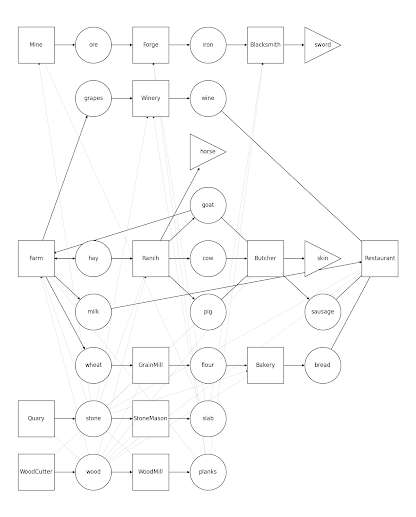
I've tried them all but in many cases node data was hard to read and links were either too large or too small. I'm working on a crafting system for a game, and want to be able to visualize recipes and item progression through the game. I want to detect useless items, or uncraftable items, as well as a system to help me balance the item crafting with the passage of time. My graph is a DiGraph that has two kinds of nodes - buildings that contain recipes, and items that can go through a building to change its form. E.g. ore -> Forge -> iron. In addition, buildings take items to be built - so there are two kinds of paths - recipe path, and construction path. Since most buildings are built from some sort of wood/stone combo there are many construction paths coming out of wood and stone. That is partially why both spring and spectral layouts tend to be clustered around wood and stone - those are the most connected nodes. Dropping those links doesn't help at all:
 |  |
| Spring layout | Spectral layout |
So I started making my own layout. Networkx's layout generators are relatively straight-forward in their API - given a graph, output a dictionary that maps nodes to their positions. Mapping all of the nodes to (0,0) for example can be done with:
pos = dict(zip(G, np.zeros((len(G), 2))))
Where G is the Graph. Since I want to show a clear relationship between nodes connecting to each other I decided to calculate nodes' position based on paths from one node to another. I tend to read left-to-right so I wanted to lay the recipes out left-to-right. We start with some source nodes - nodes that don't have any links coming to them - those are also going to be building nodes - and place them on the left most of the graph. Then we trace the connections, following only the recipe connections (not the construction ones). Each time we visit a child, we put it right of the parent, unless the spot is already taken, then we put it right, above the parent. Repeat until we are able to place all of the children. Let's convert this paragraph to code!
First, we start with some source nodes. Networkx lets you to check that with
if len(list(G.predecessors(node))) == 0:
pass
However, remember that our buildings also take construction materials. So wood and stone would be a predecessor to all of the buildings. In my particular case I can just filter nodes that aren't buildingds, but for general case we can solve this by passing a lambda for ignoring non-source nodes while placing objects:
is_construction_link = lambda child: \
G.get_edge_data(child, node) is not None and \
('type' not in G.get_edge_data(child, node) or \
G.get_edge_data(child, node)['type'] != 'construction_resource')
if len(list(filter(is_construction_link, G.predecessors(node)))) == 0:
# ready to place nodes
pass
You will likely want to change the way you check edge data, but that's my graph's data structure. From here we're ready to start placing nodes. We will need to keep track of the span for node's children, as well as an ability to move child nodes a bit up for a better alignment. We can achieve it using a doubly nested dictionary, but I created a helper class to simplify syntax a little bit and provide default values:
class Grid:
def __init__(self):
self.data = {}
def __getitem__(self, t):
col, row = t
if col in self.data:
if row in self.data[col]:
return self.data[col][row]
return None
def __setitem__(self, t, value):
col, row = t
self.data.setdefault(col, {})
self.data[col][row] = value
This makes grid to be referenced by a single square braket pair and will never complain about missing keys this allows us to quickly find an empty cell:
while grid[col, row] is not None:
row += 1
So lets review the way we want to generate this layout:
- We start at the most left and place a source node there.
- For each child of the node we place them to the right.
- Ideally we recenter parent node so that parent is aligned with the center of its children nodes
- Repeat (2.) until we don't have any more children
- Repeat (1.) until we don't have any more unvisited source nodes.
The unvisited is one of the keys there, but it will depend on how you define your source node lambda. If you use DiGraph and the G.predecessors(node) check, trace will never be able to reach those nodes since they don't have anything that can reach them, but if you use a regular Graph that won't work, so I included the visited set check to make sure we don't have infinite loops. This check also helps if you have cycles in your recipes.Let's put the whole function together:
def flow_layout(G, is_source_node):
import numpy as np
import sys
pos = dict(zip(G, np.zeros((len(G), 2))))
grid = Grid()
visited = set()
def trace(node, col, row):
def set_pos(node, col, row): # helper function
pos[node][0] = col
pos[node][1] = row
grid[col, row] = node
if node not in visited: # place only unvisited nodes
visited.add(node)
while grid[col, row] is not None:
row += 1
from_row, to_row = (row, row)
child_min = sys.maxsize
for child in G.neighbors(node):
edge = G.get_edge_data(node, child)
if 'type' not in edge or edge['type'] != 'construction_resource':
child_from_row, child_to_row = trace(child, col+1, row)
if child_from_row < child_min:
child_min = child_from_row
if child_to_row > to_row:
to_row = child_to_row
if to_row >= child_min > from_row:
from_row = child_min
# children center parents here
new_row = int((from_row+ to_row)*0.5)
while grid[col, new_row] is not None:
new_row += 1
if new_row > to_row:
to_row = new_row
set_pos(node, col, new_row)
return from_row, to_row
else: # the node has been visited
# if it's a child node that's placed to the side - recenter it
# parents center children here
if col-1 > 1 and col-1 < pos[node][0] and row > pos[node][1]+1:
avg = int((row + pos[node][1])/2)
pcol = pos[node][0]
while grid[pcol, avg] is not None:
avg += 1
old = pos[node][1]
pos[node][1] = avg
grid[pcol, old] = None
grid[pcol, avg] = node
return (0,0)
row = 1
for node in G:
if is_source_node(G, node):
tmp = trace(node, 1, row)[1]
if tmp > row:
row = tmp
return pos
And the result we get is:

Subscribe to:
Posts (Atom)
-
## Introduction Gentoo's Portage package manager uses a sophisticated dependency resolver that has evolved over two decades. Unli...
-
 Dilli, I’d like to get off Mr. Bones wild ride - Jake Logan, probably Glide wrappers can be both a savior and a menace sometimes. The game l...
-
Long time ago when I was a kid I used to play this video game that I really like... I'm not going to name it because I'm not sure if...
